This R/C Parachuting FAQ's page is in response to numerous questions about R/C Parachuting and R/C Skydiving. As of this date 27 March 99 this page is still in the construction phase. As other questions are asked I will be adding to this page. Any comments and contributions to this page will be appreciated.
At the present time the only commercial R/C Parachutist is "Para Victor" manufactured in Germany. To the best of my knowledge there is no one manufacturing R/C Parachutist in the United States. Radio Control Modeler (RCM) magazine has set of plans for an R/C Skydiver. Their plans #631 includes the layout for a round and a ram-air type parachute.
On the Little Juan parachutist the following materials are used: Basswood and Plywood for the body. 1/32" wire for the arms 1/8" wire for the legs. The control rods for the arms are made from connector links and 4-40 threaded rod. I have used foam rubber to "pad" him up. Standard servos are used for control. The standard servo arms can be used. I have also used the DuBro heavy duty servo arms. The hands and feet are gloves and boots for a Santa Claus figure. The head and helmet are from the 1/4 scale DGA pilot bust.
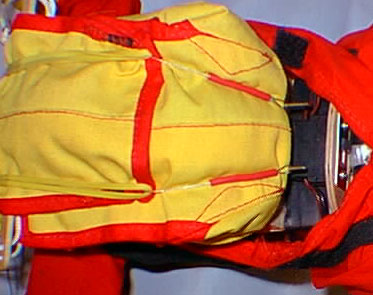
Normally retaining pins on the parachutist and retaining lock wires on the parachute pack tray are used to hold the pack tray in the closed position. When the parachutist arms are moved to the extreme down the postion the retaining pins are retracted. The parachute pack tray is opened and the parachute deploys. A servo on a separate channel could also be used to deploy the parachute. I also use small rubberbands from the risers to the pack retaining lock wires to help open the pack tray.
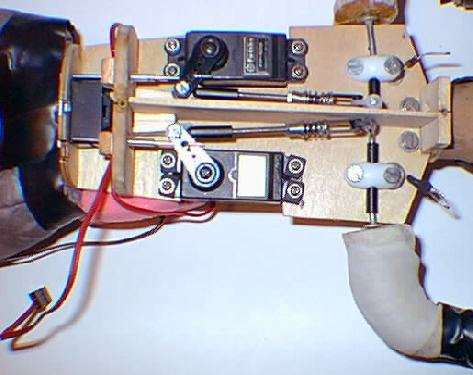
Two servos are used one is attached to the right arm and the other to the left arm. Typical controls are the Aileron servo controls the right arm and the Rudder servo the left arm. The servos should be set up so that you have almost a 90 degree arc when the arms are moved from the vertical to the horizontal position. The control sticks on the Transmitter should be pulled toward the center of the transmitter with a rubber band. The trim tab for the aileron should be in the extreme left postion and the rudder trim tab should be in the extreme right postion.
The Ram Air parachute in the RCM plan is 43" wide and 23" from leading edge to trailing edge. The parachute that came with Little Juan is 37 1/2" wide and 24 1/2" from leading edge to trailing edge. On the RCM plans the shroud lines are too long. As soon as I get all of the measurements for the lines I will post them on this site.
RCM has a set of plans for sale which includes a Ram Air type parachute and also a round parachute. If you have the sewing ability you could make up your own parachute. Other sources would be find a parachute rigger from your local skydiving center or get a kite shop to put one together for you.
This one is a no brainer. The only thing to use is ripstop nylon or regular parachute material as used in ram air parachutes. You will want to get the lightest ripstop nylon available. I don't have any experience using 1.1 ripstop nylon from a regular parchute. So I can't make any recommendations for that material.
A company called Para-Gear has some very good ripstop nylon available. The stuff that I ordered from them is listed as catalog No. W9110 ULTRA-LO-POROSITY NYLON RIPSTOP FABRIC. W9100W is approximately 64" wide and sells for $7.00 per yard. W9110N is approximately 45" wide and sells for $4.50 per yard. This fabric comes in several colors. They also sell 1.1 oz "Ripstop" nylon fabric which is 36" wide and sells for $5.00 per yard. this material comes in White, Orange, Olive Drab and Tan. Another source for parachute material is fabric store they sell what is called "Sport Ripstop Nylon". If you buy this alway get the very lightest material available. Another source for parachute fabric is your local skydiving center. You should be able to buy an old parachute for around $25.00 to $50.00. It involves a lot of work cutting up a parachute for fabric but you can get a lot of material to use. The skydiving center should be able to order fabric for you from Para-Gear.
A basic requirement for the aircraft would be a high wing model with at least 900 square inches of wing area or more. Because of the weight and drag of the parachutist you should use at least a .60 size airplane. At the present time I'm using a Senior Telemaster with a Supre Tiger .75 engine. This combination has worked out quite well for me. A 1/4 Scale airplane would also be good if you have sufficient ground clearance. I have used a Midwest Sweet Stick 60. It was alright but I would still go with a larger aircraft. You could also consider an airplane large enough to hold the parachutist inside. I'm presently working on enlarging plans for a Shorts Skyvan. It will have about 900 sq inch wing area and will use electric power.

I am using nylon straps to hold the parachutist to the airplane. In the past I have used large rubber bands but they have a tendency to stretch after they are used for awhile. I have also made a cradle to hold the parachutist straight under the aircraft. The reason for this being I once had my parachutist turn under the airplane on take off. (reference Senior Telemaster page)
The release servo is plugged into the retract gear port in the receiver. Pins are used to hold the straps in place and are retracted to drop the parachutist. This is one setup you want to keep as simple as possible.
This web page is just in the beginning stages. Anyone having other questions pertaining to R/C Parachuting is welcome to submit them to the author. If you have any questions about R/C Parachuting please feel free to e-mail me at the address below.
R/C Parachuting Home Page
Juan A. Fernandez
April 1999
E-mail: juanf@olywa.net
Copyright © 1999, Juan A. Fernandez, all rights reserved