Today, Jeff suggested that we head out to Pierce County Airport, so after take-off I turned to 060°, and we headed out over the Ft. Lewis artillery range. Seeing the ground where it had been chewed up by so many artillery shells I couldn't help but compare the scene to those of No-man's Land of the First World War, only with more greenery.
Soon, Pierce Co. airport came into view on my left, and I banked to start my descent to the southern end of the runway. This field is uncontrolled (no tower), and is 3,600 ft in length, so I was expecting a major difference between it and Olympia.
Let's be honest; the first two landings sucked.
In fact, I had to gun the engine without even landing, and climb for another
attempt. One problem was that at Olympia I have familiar visual references;
I begin a turn when I cross this road, I begin my descent over this group
of buildings, etc. At Pierce County everything was new, and gauging distances
was not that easy. Another problem was the fact that it was a cool day, and the denser air gave me more lift than usual. What made the big difference in having a decent landing was remembering to give full
flaps on my final leg. That made it easier to keep the plane at less than
60 kts as I flared above the strip. Finally, Jeff suggested that we begin
heading back to Olympia.
I readily concurred.
Wait! It gets better.
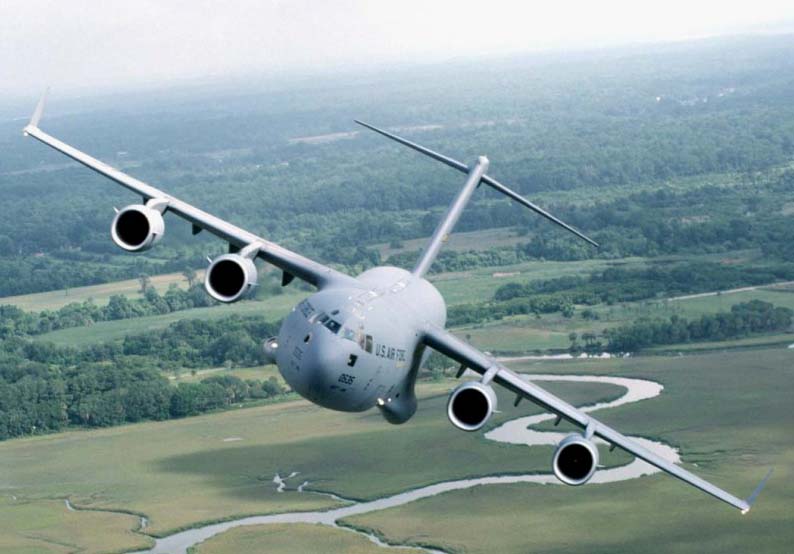
I turned to a heading of 240° which would bring us back to Olympia. The route would pass directly over McChord AFB, which was not enforcing restricted air space. By "directly", I mean right over the middle of the field. But the air traffic controller told us to fly around the southern end of the runway, and we complied. So there we were at 1,300 ft, half a mile south of a major air force base, and suddenly the controller informed us that there was a C-17 on a landing approach at 1,500 ft.
 I
looked to my left, and there was one of the world's biggest aircraft bearing
down on me. Now, I know I could have increased engine revs and descended,
and I'm sure it would have brought me far enough away from the Globemaster's
flight path, but Jeff, deciding that discretion was the better part of valor,
took the controls, turned 180°, and headed back east. At that instant
I heard the C-17 pilot inform the controller that he could not see our little
Cessna. I guess that anything that took us out of there was worth doing, and
immediately.
I
looked to my left, and there was one of the world's biggest aircraft bearing
down on me. Now, I know I could have increased engine revs and descended,
and I'm sure it would have brought me far enough away from the Globemaster's
flight path, but Jeff, deciding that discretion was the better part of valor,
took the controls, turned 180°, and headed back east. At that instant
I heard the C-17 pilot inform the controller that he could not see our little
Cessna. I guess that anything that took us out of there was worth doing, and
immediately.
In any event, it was interesting seeing this behemoth from a different perspective.
Previously, I had only seen them pass overhead.
US Air Force Photo
January 15: Today's lesson was a good one. We took off from Olympia and immediately turned west toward the coast and Hoquiam, taking advantage of 40° temperature and the added lift it provided. Climbing to 3,000 ft I flew over the nearby mountains and maintained a heading of 250°. The overcast was at 3,400 ft, with occasional clouds extending down to my altitude, but they were not thick enough to cause any difficulties.
Unlike last July, Hoquiam was not fogged in. The 5,000 ft runway sits on a spit of land jutting out into a small bay. Heading out over the water, I turned around and began my approach, using the VASI to keep me on the glide path. Surprisingly, I was right on the mark. The touchdown was a bit sloppy; cool air plus ground effect make landing a bit tricky at times, but, all in all, it wasn't too bad. We did one touch-and-go, and Jeff suggested landing at Ocean Shores, which was just on the other side of the bay.
If you look at a map of the Washington coastline, Ocean Shores is on the
small peninsula at the entrance to the bay.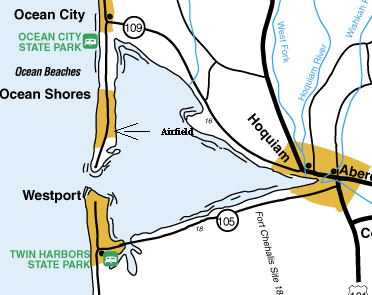 We circled the 2,000 ft field to check the windsock, and decided on a final
approach from the north. I turned for the final approach a bit too soon,
and as I crossed the beginning of the runway I was still too high. Jeff
pushed in the throttle and I climbed for another try.
We circled the 2,000 ft field to check the windsock, and decided on a final
approach from the north. I turned for the final approach a bit too soon,
and as I crossed the beginning of the runway I was still too high. Jeff
pushed in the throttle and I climbed for another try.
The second time was much better. I made the turn wider, picking a house north of the field as a reference point, and descended to the field. I stayed right on the glidepath, and touched down without any problem, although the cool air and ground effect did make the plane eat up nearly half the runway before touching down. We taxied to the end of the runway, turned around and taxied to the other end for a take-off. Ocean Shores' landing strip has no taxiways.
Keeping my feet on the brakes, I gunned the engine. With the tachometer reading just below the red line, I released the brakes and we rolled forward, quickly accelerating to 60 knots and I pulled back on the yoke. We climbed, turned eastward, and headed back to Olympia where I made a pretty uneventful landing.
Nothing special, but I now have 23 hours of flying time in my log.
February 1: Today's lesson was pretty routine. We took off from Olympia and headed straight south to Chehalis, and uncontrolled field, for touch-and-goes. It took three landings before I was able to get it right. I'm drifting too far to the left of the center line, so I have to be more aggressive with my rudder corrections. There were a few rain clouds which I skirted, and once I established some visual references I was able to gauge my approach more accurately. It's hard for a non-flyer to understand how critical a familiar reference point can be when you relationship with the ground becomes more and more immediate.
To be honest, I'm not that happy with my progress, and flying is not a cheap hobby. Additionally, a few weeks ago I had a check-up, and my blood pressure was dangerously high (152/130 - in spite of a regime of running, swimming, and avoiding meat). The doctor had me take a baby aspirin every day, and I included 1,500 mg of niacin per day, switched from ice cream to non-fat yoghurt, and made oatmeal my regular breakfast. Last week my pressure had stabilized (130/80), so I think I'll be able to pass the FAA physical. I need that in order to solo, whenever the time comes. Jeff will be the judge of that.
February 8: Today we flew down to Toledo, about 45 miles due south. There were intermittant showers, and enough turbulence to keep me on my toes, but by using I-5 as a visual reference I found the airfield with no problems. Unlike most of the fields around here, Toledo's runway goes east-west, so here was a chance to practice landing in crosswinds. And there were plenty of them. Surprisingly, in spite of the wind pushing me to the edge of the strip, my landings were not too bad. On a couple of them, I touched down at the same instant I heard the stall warning. By the fourth attempt, even staying on the center line was becoming easy.
I realize that my landings still need improving,
but I am becoming more optimistic. The old apprehension that bugged my landing
attempts is gone, and it's all becoming more or less automatic.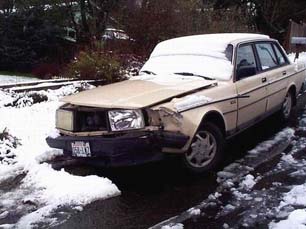
(I have to add a sad note here. A couple of weeks ago I spun out on black ice,and my car crashed into the center divide of the freeway after skidding across three lanes. Miraculously, no other vehicles were involved, but my beloved 1988 Volvo 240 was totalled - the estimate was over $6,200, and the blue book value of the car was $2,500. By the time I returned home from the flying lesson, the Volvo had been taken by the salvage company. Only an owner of a "Swedish Brick" can understand the pain and sadness I have been feeling.)