The Wild Blue Yonder Page

- Page 2 -


August 8: The schedule was off today, so we devoted the entire hour to touch and goes. I'm getting better. I feel that I have more control of the aircraft, and I'm not so dependent on reminders about setting the flaps and carbureter heat, or controlling the fuel flow.

Here's the procedure: Give 10° flaps, put on carburetor heat, turn while decreasing power and descend on the glide path. If I'm too high, cut engine revs even more, give more flaps, use the ailerons and rudder to compensate for cross-winds, keep the right hand on the throttle, and all the time the ground is rushing up to meet you while the center of the runway does not want to cooperate in lining up with the nose of the plane, estimate at what point the wheels are going to touch the ground and pull up the nose at the right instant, .................bounce..............screech................and suddenly I'm rolling on the runway. No time to bask in glory. Bring up flaps, carb heat in, full throttle, and when the air speed indicator says 60 knots, pull back on the yoke and we take off for another one.

There was quite a bit of turbulence, including a sudden updraft that gave me an unexpected 200 ft boost, but I survived. The touch-and-goes were hairy in the crosswind, but I did a fair job of keeping the plane aligned with the runway. Unfortunately, the plane bounced a few times. Not what I'd call perfect landings.

The last one was probably the best. I had to steepen the glide angle to get low enough, but over the runway I was able to pull the nose up sufficiently at the last second, and I can honestly say that it was a pretty good landing, all things considered. Jeff said I had "pulled it out of the hat". I say, "Any landing you can walk away from.............".

I was also told about the visual approach slope indicator (VASI), a series of lights that warn you if you're above or below the glide path. If you see red over red, you're too low. If it's white over white, you're too high. Red over white is fine. Sort of like Goldilocks and the three bowls of porridge. Just one more thing to add to my list of things to pay attention to.

August 13: I practiced more flying with the visor. I'm getting more comfortable with the instruments, since I didn't experience any disorientation. More landings and take-offs, this time at Chehalis. I wasn't very happy with my performance, and on one of the landings I had to abort because my speed was too high and a third of the runway was already behind us. Finally I got the concept (I hope). It's a matter of judging your distance and angle from the runway while paying attention to altitude, glide angle, flaps, engine revs and airspeed, VASI, and all the time using the rudder to compensate for the wind. Simple, no?

But I guess my last landing was a good one. In fact, I know it was. I'm still not happy with my rate of progress, but everyone has his own learning curve.

August 19: This was a good day. We flew north to Tacoma after a couple of touch-and-goes at Olympia.

Tacoma's airfield is on a cliff above the Sound. On the way up I had a bit more experience with the "hood", and this time the instrumention was easier to deal with. (Let's put it this way....we stayed in the air.) I made a couple of turns without visual reference to the horizon and it was a lot less daunting than previously.

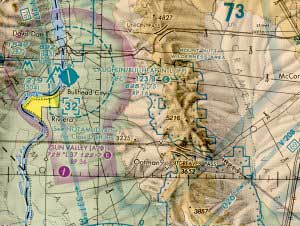
We did a couple of touch-and-goes at Tacoma before landing and taxiing to a building where I could purchase a sectional map. Learning to read one of these is a real challenge....every field is listed with information giving control tower frequency, altitude (Olympia is 200 ft above sea level) which is critical since you have to adjust your altimeter before every flight, runway length, services, radio navigation aids and frequencies, as well as the standard topological features and elevations. Map Reading 101, with lots of homework.
Pavco Flight Center at Tacoma, where I purchased the map,also sells Cessnas. New ones. We looked at a new Skyhawk. (Drool!!!!!!) The price is ONLY $145,000. (Sniff!!!)Skyhawk. I can dream, can't I?


My landings at Tacoma were the turning point, I think. I finally got the distance and angle from the runway correct as far as having enough space and time to execute the landing. Up till now I've been cutting corners, and having to extend full flaps to slow down enough. This time I got on the glide path so the VASI was showing red/white, and I was able to estimate accurately when the nose had to come up for the touchdown.

The landing back at Olympia was a very good one. I even surprised myself! I'm a lot more confident about this than I have been up till now.

August 26: We did touch-and-goes for an hour. While some of my landings are OK, some of them show that I'm a long way from being a good pilot. I still have a long way to go in mastering this "flaps/carb heat/engine speed" manuever.

August 30: We got a late start because of overcast. The FAA wants three miles of visibility, and we had 1.5 miles until 11:30. Rapid clearing of the clouds meant winds, and they hit at 700 ft. As before, some of the landings were OK, but some of them made me think the front strut would collapse.

Jeff suggested I give full flaps on the final approach, and, as I came near the ground, give a bit more power and pull the nose up. Try to fly just above the runway.

Well, I didn't exactly fly above the runway, but by pulling up the nose enough and giving more power I made two good landings in a row. I guess this will eventually become automatic. At least I hope it will.


September 1: All we did today were touch-and-goes. While I'm getting better at it, I'm still not satisfied with my landings. At least the instructor doesn't break out in a cold sweat. That's a good sign, I think.

In left turns, the nose tends to rise, causing a drop in air speed. I manage to keep the nose down, and I'm using the rudder more than I did before.

I'm remembering to pay attention to the air speed indicator while making my final turn and approach. This made a big difference in having to add power at the last minute. As long as I keep the speed above 60 knots things seem to go more smoothly. Still, this is no piece of cake. It requires a lot of concentration on many things at once, and a one hour lesson can be pretty tiring.

September 5: We flew to Shelton to practice landings. Sanderson Field at Shelton has a 5,000 ft runway and is an uncontrolled field (i.e. no tower), but it does have VASI. A few clicks on my radio button as we approached turned on the lights. The first landing sucked. There's no arguing that point. But subsequent landings were much better, especially after I found some visual references to base my turns and descents on. The final landing was wobbly, and the left wheel touched a second before the right, but it was fairly smooth.

Every landing adds to my experience, and every flight gives me more confidence in using the instruments.

September 8: The airfield was crowded today. There was a collection of warbirds (WWII-era fighters, trainers, and even an old Grumman TBM "Avenger") as well as some jets. Someone even had a Sukhoi SU-29 aerobatic trainer there. We had to do our touch-and-goes between landings and take-offs of these veteran aircraft. At one point, Jeff took the controls and flew just above the runway, going into a steep climb at the end, just to "show them what a Cessna can do". Of course, we had been buzzed by a North American P-51 Mustang, the "Avenger", and a couple of T-6 "Texans". It's nice to get even.

I did well, I think. Even in the last couple of landings (we were landing toward the North), with the aid of VASI, when I came in too low, I managed to add enough power and touch down with little difficulty. I think I'm finally getting the hang of this. I should be. Today's lesson brought the total to 12 hours of instruction.

Later, Lynn and I returned to the airfield and got some pictures of the assembled relics.


September 11: An unspeakable horror was visited on the United States today.
Religious fanatics, knowing no moral bounds and fueled by absolute hatred for us and our allies, hijacked four civilian airliners and crashed three of them into buildings that symbolized our nation, murdering thousands of innocent people in the process. Some of the passengers on a fourth airliner fought the hijackers, sacrificing their lives to prevent a greater disaster. The criminals will learn, as have others in the past, that we, as a nation, are slow to anger, but swift in our response, and absolute in our revenge.

September 11, 2001
American Airlines Flight 11
American Airlines Flight 77
United Airlines Flight 175
United Airlines Flight 93
World Trade Center  
The Pentagon
Honoring the memories of those who died.


September 22: For obvious reasons, civilian flying was non-existant for the last couple of weeks.

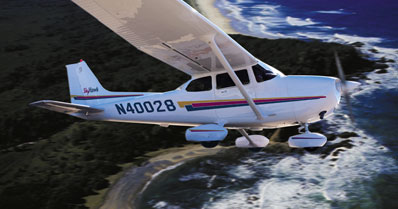
Finally, we got permission for VFR flying, and when we got to the airfield, Jeff asked Lynn if she wanted to come along. This meant flying the Cessna 172 (Skyhawk). I had forgotten how much more stable this model is, especially with an extra passenger aboard.
We practiced a couple of touch-and-goes (one not so good, one pretty good), then headed north for a couple of turns over Olympia.

We flew over the house a couple of times until Lynn was able to pick out my car parked in front, then we headed out over the Sound. Sighting a tug pulling a load of logs, I circled it a couple of times.

Lynn has been a resident of Olympia for over a dozen years, yet she never realized how much water is around us. You can't get a good perspective from a commercial jetliner, but a few turns at 1200 feet really make the eyes take notice.

Afterward, we returned to the airfield. The 172 requires a lot more muscle than the 152, so it was tricky getting lined up correctly, while trying to compensate for the wind. But the final landing was one of my best.


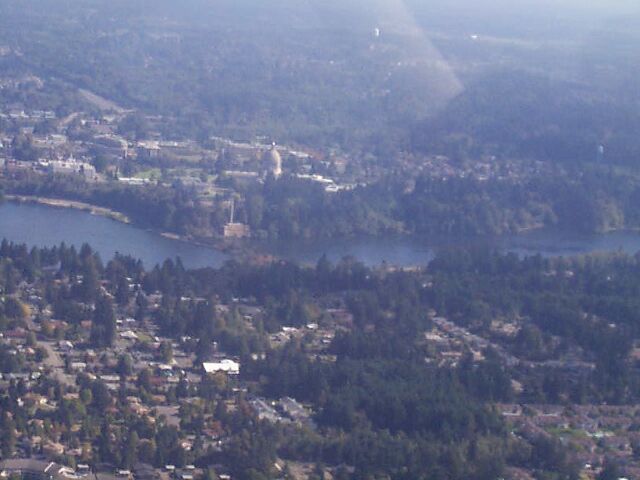
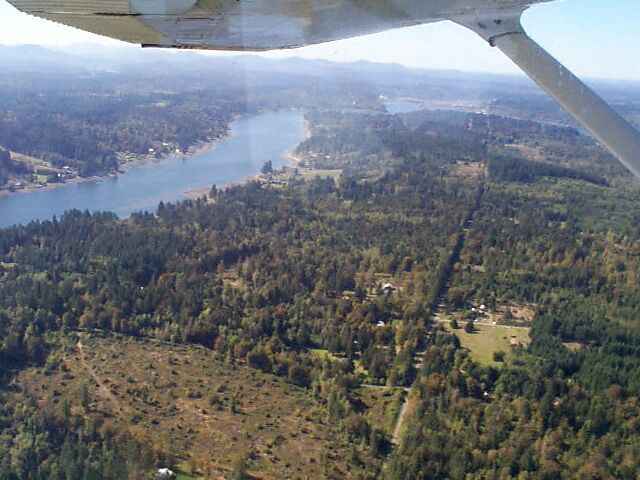
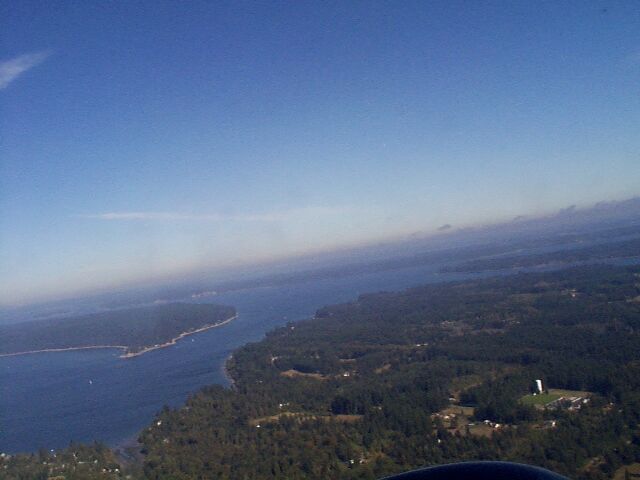
September 30: This time Lynn had planned on coming along, so she brought the camera. This one was off

The state capitol from 1,200 feet.
Olympia and Puget Sound from the air.
It only took one visit to convince me that I belonged here.

The view is awesome. Water, water everywhere.
the cuff, just a chance to get in some more time without a prearranged plan. Once again, we took the Skyhawk....I took off, turned for a quick touch-and-go, then we headed north. Some areas were still restricted, so we didn't continue too far in that direction. I circled around a group of sailboats participating in what appeared to be a regatta. Then I headed southwest toward Shelton, and turned back east to Olympia.
Although the winds were somewhat unpredictable, with sudden gusts even at 1,200 feet, the Skyhawk proved a very stable and forgiving beast.

Because of the winds had to land from the south. That end of the runway, has the VASI to keep me in the glidepath. I did one touch-and-go with a stiff crosswind, and the landing was not that great. However, the second one was pretty good. I managed to fight the drift to the left, lined the plane up with the center of the runway, and although my glide path was a bit low I was able to bring up the nose at the last second and made a damn good landing.

I've gotten over my apprehension in landings. Unfortunately, Jeff will be on vacation for most of October, so after next weekend this journal will be on hiatus.


Links


Home Page

e-mail

© 2001 Michael Baram